Orthodox Christianity is learned most deeply by worshiping with the Church. The services are not only lessons about doctrine; they are the living prayer of the Church. They shape how Orthodox Christians understand God, the human person, repentance, the saints, Scripture, and salvation.
Not invented weekly
Orthodox worship is received from the Church and prayed across generations, not redesigned around private preference.
The whole person prays
Standing, bowing, icons, incense, chant, candles, Scripture, and Communion teach that salvation includes body and soul.
Parish before internet
Reading can help, but Orthodox worship is learned inside the concrete life of a parish under bishop and priest.
Worship As Formation
Orthodox worship is not content about God; it is the Church standing before God.
The services form a person slowly. Scripture, icons, hymns, incense, fasting seasons, sacraments, and parish obedience are not separate interests. They belong to one worshipping life.
Real Orthodox worship is learned by attending services, not by collecting explanations online.
The Divine Liturgy gathers Scripture, thanksgiving, offering, Eucharist, and the Church's common prayer.
Vespers, Matins, the Hours, feasts, fasts, and saints teach that the whole year can be offered to Christ.
Morning prayer, evening prayer, icons, Scripture, fasting, and mercy should echo parish worship without replacing it.
Worship Reality System
Orthodox worship is received as a living order, not assembled as religious content.
The Church does not build worship from a sermon, a playlist, and personal taste. Orthodox services gather Scripture, Eucharist, icons, hymnography, incense, blessing, repentance, time, and the faithful body into one ecclesial act before God.
The service gathers offering, Scripture, Creed, prayer, and Holy Communion as the Church's common act.
Psalms, apostolic readings, Gospel, prophecy, and biblical hymns saturate the services beyond a lecture format.
Standing, bowing, crossing, venerating, listening, singing, fasting, and receiving blessings form embodied attention.
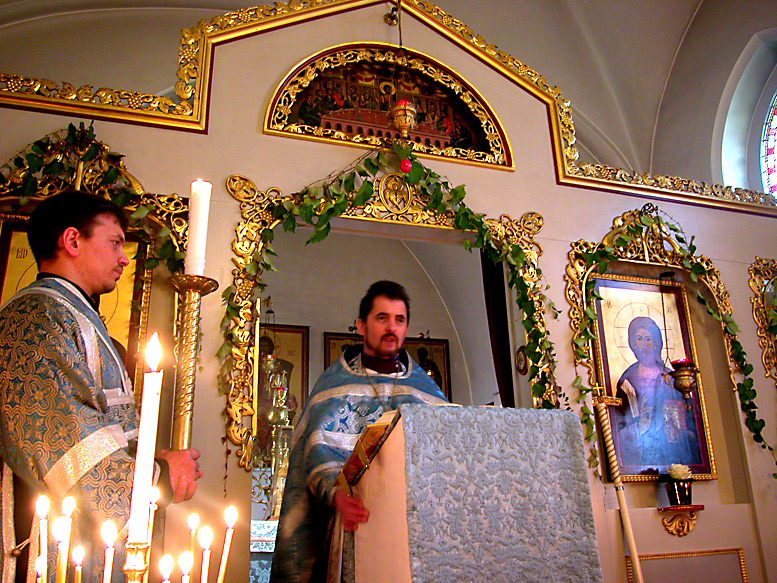
Icons, candles, incense, vestments, and sacred space serve prayer, reverence, repentance, and the confession of the Incarnation.
Orthodox worship teaches that the week and year can become remembrance, preparation, thanksgiving, and repentance.
Books and apps can orient the reader, but the parish, priest, bishop, services, and faithful community are the real school.
Worship study path
Start with the Divine Liturgy, then learn how daily prayer, icons, sacraments, Scripture, and the Church year belong together.
Choose A Path
Start with the question actually in front of you.
Orthodox worship is easier to enter when the next step is concrete: a first visit, the Divine Liturgy, icons, the daily cycle, the Mysteries, or parish life.
Worship Literacy
How to read Orthodox worship without flattening it.
Orthodox worship is often misunderstood when it is treated as atmosphere, ethnicity, ceremony, or a sermon with ancient decoration. A better first map is to ask what the Church is doing: gathering, praying Scripture, confessing the faith, offering thanksgiving, receiving sacramental life, and being sent back into the world.
The Divine Liturgy at the center
The Divine Liturgy is the central Eucharistic service of the Orthodox Church. It joins psalms, litanies, apostolic readings, the Gospel, the Creed, thanksgiving, offering, and Holy Communion. It is not a performance watched from a distance; it is the common worship of the Church.
Five layers of Orthodox worship
Orthodox worship is easier to understand when its layers are seen together. A visitor may first notice icons or chant, but the full pattern includes the Eucharistic center, the daily cycle of services, the Church year, the holy mysteries, and the parish as a living community.
| Layer | What it includes | Why it matters |
|---|---|---|
| Divine Liturgy | Scripture, offering, thanksgiving, Eucharist, and Communion. | The Eucharistic center of parish worship. |
| Daily cycle | Vespers, Matins, Hours, Compline, and related services. | Prayer shapes time beyond Sunday morning. |
| Church year | Pascha, feasts, fasts, saints, and seasons. | The Gospel is taught through time. |
| Holy Mysteries | Baptism, Chrismation, Eucharist, Confession, Marriage, Ordination, and healing. | Sacramental life is not separate from worship. |
| Parish life | Priest, bishop, community, catechesis, service, and hospitality. | Orthodoxy is lived in the Church, not alone online. |
Worship Architecture
Orthodox worship is a whole ecology, not one Sunday moment.
The Divine Liturgy is central, but it belongs inside a larger pattern: daily services, feasts and fasts, sacraments, Scripture, icons, parish life, and home prayer. Pulling one piece away from the others makes Orthodox worship look stranger and thinner than it is.
The parish gathers around Scripture, thanksgiving, offering, and Holy Communion. This is the heart of Orthodox worship, not a weekly religious presentation.
Read the Liturgy guideVespers, Matins, Hours, Pascha, feasts, fasts, and saints teach that time itself can become prayer and remembrance before God.
Read the daily cycle guideOrthodox worship does not treat the body as an obstacle. Sight, sound, movement, posture, and space are disciplined toward attention and reverence.
Read the icons guideThe services are not private spirituality. They are the prayer of the Church under pastoral order, with concrete people learning repentance together.
Read the parish life guideHow To Begin
Start small, attend repeatedly, and let the parish teach you.
A beginner does not need to decode every movement. Orthodoxy is learned by repeated presence: listening, asking, praying, and slowly seeing how the same themes return.
- First serviceAttend Vespers or Divine Liturgy quietly. Do not worry about mastering gestures, books, or every word.
- First monthReturn enough times to notice patterns: litanies, Gospel, icons, candles, the Creed, the Theotokos, saints, and Communion discipline.
- First questionsAsk about catechism, service books, parish language, Communion boundaries, and how to begin a modest prayer rule.
- First habitLet one small home practice echo parish worship: morning prayer, evening prayer, Scripture, a saint of the day, or fasting awareness.
What Orthodox worship is not
Orthodox worship is not designed as religious entertainment, a lecture with music, or a private spiritual atmosphere created for individual preference. The services belong to the Church before they belong to any visitor's taste. They are received, repeated, sung, and prayed until the faithful are slowly trained to repent, give thanks, listen, and stand before God.
This also protects the services from becoming an aesthetic project. Icons, chant, candles, vestments, processions, and incense are beautiful, but beauty is not the final goal. They are ordered toward worship of the Father, Son, and Holy Spirit, and toward participation in the life of Christ.
Beauty is not the point by itself
Many people first notice Orthodox worship because it is beautiful. That can be a doorway, but beauty must lead to repentance, thanksgiving, humility, and parish life. If worship becomes only an aesthetic experience, its deepest purpose has been missed.
Prayer with the whole person
Orthodox worship involves the body as well as the mind: standing, bowing, making the sign of the Cross, venerating icons, lighting candles, hearing chant, smelling incense, and receiving blessings. These actions are not decoration. They teach that salvation concerns the whole human person.
This is one reason Orthodox services can feel unfamiliar to people used to worship as mainly listening, reading, or thinking. The body is not bypassed. It is taught to stand before God with attention, humility, repentance, and thanksgiving.
Scripture inside worship
Orthodox services are filled with Scripture. Psalms, Gospel readings, apostolic readings, Old Testament prophecy, and biblical language are woven through the hymns and prayers. The Bible is read in the Church's worshiping life, not treated as an isolated text detached from prayer.
A visitor may not recognize every biblical echo at first, but the services are saturated with Scripture. The faithful learn the Bible by hearing it proclaimed, sung, prayed, interpreted in feasts, and connected to the Eucharistic life of the Church.
The church building as a theological space
An Orthodox church is arranged to teach. The iconostasis, altar, nave, icons of Christ and the Theotokos, candle stands, Gospel book, cross, and processional movement all communicate that worship is entry into the Kingdom, not a meeting held in a neutral room. Visitors may not understand every detail at first, but the space itself invites reverence and attention.
The point is not to decode every symbol instantly. A newcomer can simply stand, listen, watch with respect, and allow the services to form questions slowly. Orthodoxy is often understood by repeated attendance before it is explained in a tidy sequence.
Daily services and the Church year
The Divine Liturgy is central, but it does not stand alone. Vespers, Matins, the Hours, Great Compline, Presanctified Liturgy in Great Lent, Holy Week services, and feast-day services all teach the faith through time. The Church year gives worship a rhythm of fasting and feasting, repentance and joy, preparation and fulfillment.
This matters because Orthodox life is not only a Sunday event. The same prayer that gathers the parish also shapes the home: morning prayers, evening prayers, Scripture, fasting awareness, saints, and the remembrance of feasts.
Worship as a school of theology
Orthodox worship teaches doctrine by praying it. The Trinity is praised in doxologies. The Incarnation is confessed through feasts and icons. The Resurrection is proclaimed every Sunday. The Mother of God and the saints are remembered in relation to Christ. The faithful do not only learn definitions; they are formed by repeated participation in the Church's prayer.
This is why Orthodox theology can feel dense to outsiders. The faith is not arranged as a modern lecture first and a worship experience second. It is received as a whole life: Scripture, hymnography, fasting, confession, Communion, icons, saints, calendar, and parish obedience working together over time.
How to participate as a visitor
A visitor does not need to imitate everything immediately. It is enough to arrive respectfully, silence the phone, stand or sit where possible, avoid photographing worship without permission, and ask questions after the service rather than during solemn moments. If people bow, cross themselves, or venerate icons, observe first and ask later.
Many parishes offer coffee hour or fellowship after the Divine Liturgy. That is often the best time to meet people, ask about service books, and introduce yourself to the priest. Worship is central, but it is not isolated from parish hospitality and instruction.
Visitors and Communion
Visitors are welcome to attend services, listen, and ask questions. In normal Orthodox practice, Holy Communion is received by Orthodox Christians who are prepared according to the guidance of the Church. Non-Orthodox visitors should not approach the chalice, but they may often receive blessed bread after the service depending on local custom.
Worship and daily life
The point of worship is not to escape ordinary life. The Liturgy sends the faithful back into the world with repentance, gratitude, mercy, and attention. Prayer at home, fasting, confession, almsgiving, and care for neighbors are all strengthened by the Church's worship.
Beauty and sobriety
Orthodox worship can be visually and musically beautiful, but the beauty is disciplined. It is not meant to flatter religious taste or create a theatrical mood. Icons, chant, vestments, incense, and candlelight are ordered toward reverence, repentance, thanksgiving, and communion with God.
This matters for modern readers because Orthodox worship is often discovered first through images online. A photograph may attract attention, but the real meaning of the worship is only learned by entering the parish's prayer with humility and patience.
Why repetition matters
Modern readers sometimes assume repetition means lack of creativity. Orthodox worship sees repetition differently. Repeated litanies, psalms, doxologies, hymns, and responses allow the Church to pray with one voice and allow the heart to be trained slowly. Repetition is not filler; it is formation.
This is especially important for visitors. The first service may feel overwhelming. By the third or fourth visit, patterns begin to appear: petitions for mercy, praise of the Trinity, remembrance of the Theotokos and saints, Scripture, the Cross, Resurrection, and the Kingdom. The service teaches by returning again and again to what matters.
Common questions about Orthodox worship
Why is worship so central?
Orthodox worship is central because the Church prays what she believes. Doctrine, Scripture, icons, sacraments, fasting, saints, and the Church year are received inside the common prayer of the Church.
Is Orthodox worship only symbolic?
No. Orthodox worship uses symbols, but it is not merely symbolic. The Church understands worship as real participation in prayer, thanksgiving, repentance, sacramental life, and communion with God.
Can someone learn Orthodoxy just by reading?
Reading can help, but Orthodoxy is learned most deeply through worship, parish life, sacraments, prayer, repentance, and pastoral guidance.
What Orthodox service should a visitor attend first?
Sunday Divine Liturgy is the central parish service, while Vespers can be a quieter first doorway in many parishes. Check the parish schedule, arrive respectfully, and ask practical questions after the service.
Why does Orthodox worship involve the body?
Orthodox worship involves standing, bowing, the sign of the Cross, icons, incense, candles, chant, and Communion because Christian prayer concerns the whole human person, not only ideas.
Source note
This worship overview follows Orthodox catechetical teaching on the Divine Liturgy, daily services, icons, Scripture, sacraments, and parish life. Local service patterns vary by parish and jurisdiction.
Source Trail
Read this topic with the Church, not only the internet.
These links give a cautious path for checking the topic further. They do not replace parish worship, confession, pastoral guidance, or the calendar used by your bishop and local parish.
Daily Rhythm
Carry worship into the week.
The app helps readers keep daily prayers, Scripture, fasting awareness, saints, and the Church calendar close between services, while leaving concrete pastoral guidance to the parish.
Local customs, languages, calendars, and service schedules vary. For concrete guidance, follow your parish and speak with the priest.