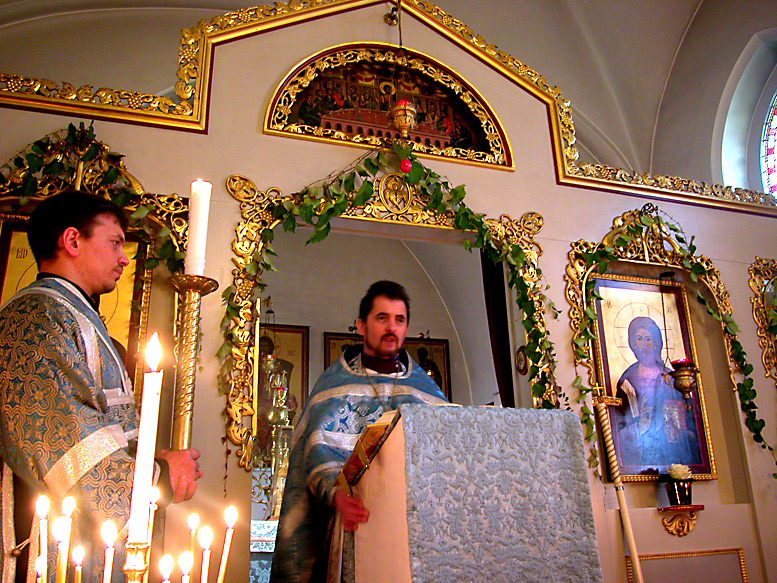
In Orthodox usage, liturgy means common work or common action. The Church gathers as the people of God to pray, hear the Word, offer thanksgiving, and receive Christ in the Holy Eucharist. Because of this, the Divine Liturgy stands at the center of Orthodox Christian life.
The Church gathers
The Liturgy is not a private devotion or a religious event watched from outside. It is the common worship of the Church.
Scripture leads to offering
The service moves through Scripture, prayer, thanksgiving, the Eucharistic offering, Communion, and return to daily life.
Full unity
Holy Communion expresses shared Orthodox faith and sacramental life, so visitors are welcomed without being invited to the chalice.
Worship First
Do not reduce the Liturgy to ceremony, sermon, or Communion line.
The Divine Liturgy is one movement of the Church: gathered prayer, Scripture, offering, thanksgiving, Holy Communion, and a return to the world with Christ's peace.
A visitor can stand, listen, and observe without performing every gesture perfectly.
The Epistle, Gospel, psalms, hymns, and homily are not detached teaching moments; they are prayed in the Church.
The Great Entrance and Anaphora reveal thanksgiving, remembrance, and the offering of the whole life to God.
Communion is received by prepared Orthodox Christians; visitors are still welcomed to pray, learn, and speak with the parish.
Eucharistic Movement System
The Divine Liturgy gathers the Church into one movement of thanksgiving and communion.
Orthodox worship is not assembled from separate religious moments. Proskomide, Scripture, litanies, offering, Anaphora, Communion, and dismissal belong to one eucharistic action in which the Church gives thanks, receives Christ, and is sent back into the world.
The Liturgy is the common work of prayer, response, attention, and offering before God.
Psalms, Epistle, Gospel, hymns, and homily form the Church's hearing of the Word.
Proskomide and the Great Entrance teach that bread, wine, and human life are offered to God.
The Church prays what she believes: Trinity, Incarnation, Cross, Resurrection, Spirit, saints, and Kingdom.
The guarded chalice protects the meaning of full Orthodox faith, preparation, and sacramental unity.
Sunday worship should shape mercy, repentance, prayer, fasting, and ordinary responsibilities.
Divine Liturgy Discernment Guide
The Liturgy is learned by worshipping, not by decoding every detail at once.
A first visit can feel dense. The safer path is to follow the main movement: gather, hear Scripture, offer, give thanks, respect Communion, and return with questions.
Eucharistic Worship
Understand the Divine Liturgy as one Eucharistic movement, not separate religious moments.
The Liturgy gathers the Church into prayer, Scripture, offering, thanksgiving, Communion, and sending forth. A visitor may notice many details at once, but the deeper shape is one movement of the Body of Christ toward the Kingdom.
Worship cluster
This page belongs to the wider worship cluster: parish worship, daily services, sacraments, icons, and preparation for Communion.
Two main movements
The Liturgy is often described in two broad movements: the Liturgy of the Word and the Liturgy of the Faithful. The first is centered on psalms, hymns, apostolic readings, and the Gospel. The second is centered on the Eucharistic offering, thanksgiving, and communion.
Divine Liturgy learning sequence
Follow the service as one movement of preparation, Scripture, offering, thanksgiving, Communion, and sending forth.
| Movement | What happens | Why it matters |
|---|---|---|
| Proskomide | The gifts of bread and wine are prepared before the public part of the service. | The offering of the Church is prepared with prayer and remembrance. |
| Liturgy of the Word | Litanies, antiphons, hymns, Epistle, Gospel, and often a homily. | The Church hears the Word of God within worship. |
| Great Entrance | The prepared gifts are carried in procession to the altar. | The faithful offer themselves and the whole life of the world to God. |
| Anaphora | The Eucharistic prayer of thanksgiving, remembrance, and invocation. | The Church gives thanks and prays for the Holy Spirit to act. |
| Holy Communion | Prepared Orthodox faithful receive the Body and Blood of Christ. | Communion is participation in Christ, not a symbolic snack or private devotion. |
Field Guide
What is happening beneath what a visitor sees?
A first visit can feel like a wall of sound, movement, candles, icons, and unfamiliar gestures. The deeper shape is simpler: the Church gathers, prays the Scriptures, offers thanksgiving, receives Christ, and is sent back into the world.
These are not theatrical decoration. They teach the body to worship and help the parish pray as one people.
The Liturgy is saturated with Scripture, but Scripture is heard inside prayer rather than isolated as a lecture.
The gifts are not a religious prop. The Church offers bread and wine, gives thanks, and receives the Body and Blood of Christ.
Communion and preparation are concrete parish realities. A guide can explain the meaning; the local priest gives personal direction.
For Visitors
You can attend without pretending you understand everything.
The most respectful posture for a first visit is simple: arrive quietly, observe, stand or sit as needed, listen to the Gospel, do not approach Communion unless you are Orthodox and prepared, and ask questions afterward.
- Before the serviceCheck the parish schedule, arrive a little early, silence your phone, and enter without pressure to perform every gesture correctly.
- During the serviceFollow the parish's lead. If people stand, bow, cross themselves, or venerate icons, observe first and ask later.
- At CommunionRemain in place unless you are an Orthodox Christian prepared according to your parish's guidance. This boundary is theological, not personal rejection.
- AfterwardIntroduce yourself if possible. Ask about catechism, service books, parish customs, and the best next service to attend.
Preparation of the gifts
The Proskomide is often hidden from a first-time visitor, but it matters deeply. Bread and wine are prepared with prayer before the public part of the Liturgy. The living, the departed, the saints, the Theotokos, and the whole Church are remembered around the offering.
This quiet preparation teaches that the Eucharist is not an isolated ritual moment. The Church brings real lives, names, griefs, thanksgiving, repentance, and hope before God.
The Word is heard inside worship
The Epistle and Gospel are not readings dropped into a meeting. They are proclaimed within prayer, hymns, processions, incense, and the gathered Church. The Gospel book is treated with reverence because Scripture is received as the living word of God in the worshipping Church.
A homily may follow, but the Liturgy is not dependent on a sermon as its center. Scripture, prayer, and Eucharistic offering form one movement.
The Great Entrance is not a stage moment
The Great Entrance can look dramatic to a visitor, but it is not theatre. The prepared gifts are carried to the altar as the Church offers herself and the whole life of the world to God. The faithful pray, remember, and stand with attention.
The Anaphora means thanksgiving
The Eucharistic prayer is the great prayer of thanksgiving. The Church remembers God's saving work, offers praise, and invokes the Holy Spirit. The language is theological because worship is theological; the Church prays what she believes.
Communion is the center, not a symbol of friendliness
Holy Communion is participation in the Body and Blood of Christ. This is why Orthodox Communion discipline is serious. It is not a general gesture of welcome, a reward for being sincere, or a symbolic snack. It expresses full communion in the faith and sacramental life of the Church.
Visitors are still welcome. They can attend, pray, listen, ask questions, and often receive blessed bread according to local custom. But Communion itself belongs to prepared Orthodox Christians under the guidance of the Church.
Welcome does not mean open Communion
Orthodox parishes should welcome visitors warmly, but Holy Communion is not used as a general hospitality gesture. The boundary protects what Communion means: unity in the Orthodox faith, sacramental life, repentance, preparation, and the blessing of the Church.
The Liturgy of Saint John Chrysostom and Saint Basil
Most Sundays use the Divine Liturgy of Saint John Chrysostom. The Liturgy of Saint Basil is used on appointed days, especially in Great Lent and certain great feasts. Both belong to the same Eucharistic life of the Church, but their prayers differ in length and theological density.
Sunday and the Resurrection
The Divine Liturgy is especially associated with Sunday, the Lord's Day, the day of Christ's Resurrection. It is also celebrated on many feast days and, in monasteries and some parishes, more frequently according to local practice.
What a first-time visitor notices
A visitor may notice standing, incense, chanting, icons, processions, repeated litanies, the sign of the cross, candles, and people entering or leaving quietly. These are not random customs. They form a whole bodily and communal way of prayer.
It is normal not to understand everything at once. Orthodox worship is learned by repeated attendance, listening, asking, and gradually recognizing the patterns of the service.
Communion and preparation
Holy Communion is the sacramental participation in the Body and Blood of Christ. In Orthodox practice, reception of Communion belongs to Orthodox Christians who are living the life of the Church and preparing according to the guidance of their priest and local tradition.
Why non-Orthodox visitors do not receive Communion
In Orthodoxy, Communion is not a general sign of welcome or personal sincerity. It expresses full communion in the faith, sacramental life, and discipline of the Orthodox Church. Visitors are welcome to attend, pray, and speak with the priest, but receiving Communion is reserved for Orthodox Christians prepared according to local practice.
What a visitor can do
Visitors are normally welcome to attend and observe. A first visit is best approached with humility: stand where you are comfortable, listen, follow the parish's lead, and ask questions afterward rather than trying to understand everything at once.
The Liturgy teaches doctrine through worship
The Divine Liturgy is one reason Orthodoxy cannot be reduced to private opinion. The prayers confess the Holy Trinity, the Incarnation, the Cross, the Resurrection, the work of the Holy Spirit, the communion of saints, and the hope of the Kingdom. A person learns the faith not only by reading explanations, but by hearing the Church pray.
Why the Liturgy is not a lecture
The Divine Liturgy contains teaching, but it is not arranged as a classroom presentation. It forms the faithful through repeated prayer, Scripture, movement, silence, response, thanksgiving, and sacramental participation. This is why someone may understand more after attending several times than after reading a single explanation.
A visitor should not feel embarrassed by confusion. The Liturgy is deep because it gathers the whole Gospel: creation, fall, promise, Incarnation, Cross, Resurrection, Ascension, Pentecost, Church, Communion, judgment, and the Kingdom. The Church does not compress that mystery into a short talk.
What the Liturgy does to time
The Divine Liturgy does not simply occupy part of Sunday morning. It reorders time around thanksgiving and the Kingdom of God. The faithful bring the week, the departed, the sick, the living, the world, and their own repentance into prayer. Then they are sent back into ordinary life with the memory of Christ.
This is why daily prayer belongs with Sunday worship. Morning prayers, evening prayers, fasting awareness, saints, and Scripture should not become a parallel private system. They prepare the person to return to the Liturgy with attention and to live after the Liturgy with mercy.
Common questions about the Divine Liturgy
What does Divine Liturgy mean?
In Orthodox usage, liturgy means common work or common action. The Divine Liturgy is the Eucharistic worship of the Church gathered in prayer, Scripture, thanksgiving, and Communion.
Can visitors receive Communion?
Visitors are welcome to attend and pray, but Holy Communion is reserved for prepared Orthodox Christians because it expresses full communion in faith and sacramental life.
Why so much singing and repetition?
Orthodox worship uses repeated litanies, psalms, hymns, and responses to form the heart in prayer and allow the whole Church to participate. Repetition is not filler; it is part of liturgical formation.
Can non-Orthodox people attend the Divine Liturgy?
Yes. Visitors are normally welcome to attend, observe, pray, listen, and ask questions afterward. The important boundary is Communion, which belongs to prepared Orthodox Christians.
What should a first-time visitor do during Communion?
Remain in place unless you are an Orthodox Christian prepared according to your parish's guidance. This boundary is theological, not a personal rejection.
Is the Divine Liturgy mainly a sermon?
No. A homily may teach, but the Liturgy itself is worship: Scripture, prayer, offering, thanksgiving, Eucharist, and sending forth into daily life.
Source note
This guide follows Orthodox catechetical explanations of the Divine Liturgy and keeps local preparation for Communion under parish and priestly guidance.
Source Trail
Read this topic with the Church, not only the internet.
These links give a cautious path for checking the topic further. They do not replace parish worship, confession, pastoral guidance, or the calendar used by your bishop and local parish.
Prepare With Peace
Let daily prayer lead back to the Liturgy.
Orthodox Daily Prayer helps keep Scripture, prayer, fasting awareness, saints, and the Church calendar close between parish services.
Practices around preparation, confession, fasting, and receiving Communion can vary by parish and jurisdiction. Speak with the local priest for concrete guidance.