Orthodox Pentecost belongs to the Paschal cycle. It is not a disconnected spring feast. The Resurrection, Ascension, and Pentecost belong together: Christ rises from the dead, ascends in glory, and sends the Holy Spirit.
Pentecost completes the Paschal season and moves with the date of Pascha.
The feast proclaims the descent of the Spirit and the life of the Church in God.
Pentecost leads to witness, parish life, prayer, and the saints as the fruit of the Spirit.
Pastoral note
Pentecost should not be reduced to religious energy, aesthetics, or a private spiritual experience. The Holy Spirit gathers the Church, forms holiness, and sends witness rooted in worship, sacraments, repentance, and love.
The Spirit Forms The Church
Pentecost completes the Paschal season by revealing the life of the Church in the Holy Spirit.
The feast is not vague spiritual energy. It is the gift of the Holy Spirit, the manifestation of the Church, the revelation of the Trinity, and the beginning of apostolic witness.
The fiftieth day shows that Pentecost fulfills the Resurrection rather than replacing it.
The Spirit is Lord and Giver of Life, worshiped with the Father and the Son.
The Spirit unites many peoples in the confession of Christ without erasing real languages and nations.
Pentecost bears fruit in prayer, sacraments, mission, saints, repentance, and love.
Pentecost Doctrinal System
Pentecost is not a mood. It is the Church receiving the promised Holy Spirit.
Orthodox Pentecost holds several truths together at once: the risen Christ has ascended, the Father sends the Holy Spirit, the apostles are gathered and sent, the Trinity is confessed, and holiness appears as the Spirit's fruit in real human lives.
Pentecost belongs to the Paschal season and cannot be read apart from Christ risen from the dead.
The feast is not spiritual improvisation; it follows the saving movement from Resurrection to Ascension to Pentecost.
Orthodox worship confesses the Spirit personally, divinely, and together with the Father and the Son.
The feast teaches communion with the Father, through the Son, in the Holy Spirit.
The apostles receive power to proclaim Christ to the nations while remaining rooted in the Church.
The Spirit's work becomes visible in martyrs, confessors, monastics, pastors, families, and hidden holy people.
Pentecost Map
How to understand Pentecost without flattening it.
Pentecost is not only a date, a green decoration, or a vague spiritual feeling. It completes the Paschal season: the risen and ascended Christ sends the Holy Spirit, and the Church lives in the Holy Trinity.
Orthodox Pentecost learning sequence
Read Pentecost as the fulfillment of the Paschal season and the living breath of the Church.
Fifty days after Pascha
The name Pentecost points to the fiftieth day. In Orthodox worship, this feast completes the movement of the Paschal season. The joy of the Resurrection is not left behind; it is fulfilled in the gift of the Holy Spirit.
Because Pentecost depends on the date of Pascha, it is a movable feast. Local calendars publish the exact date each year, along with the parish service schedule.
The descent of the Holy Spirit
The feast remembers the descent of the Holy Spirit upon the apostles. Orthodox Christianity does not treat this as only a past event. Pentecost reveals the Church as the life of Christ continuing in the Holy Spirit.
The language of fire and tongues
The Acts account speaks of the Spirit's descent with signs of wind, fire, and tongues. Orthodox worship receives this as the revelation of divine life and mission, not as religious spectacle. The apostles are not given spiritual excitement for its own sake; they are empowered to proclaim Christ.
The reversal of confusion is also important. Where human pride scatters and confuses, the Holy Spirit gathers people into the one confession of Christ without erasing real nations and languages. Pentecost is therefore both unity and mission.
Mission without individualism
Pentecost sends the apostles, but not as isolated religious entrepreneurs. They preach as witnesses of the risen and ascended Christ, in the life of the Church, through the grace of the Holy Spirit. Mission is not branding, self-expression, or personal platform. It is the Spirit-bearing proclamation of Christ.
This matters for a modern Orthodox website and app. Reaching many people should not mean thinning the faith into slogans. Pentecost calls the Church outward while keeping her rooted in worship, sacraments, doctrine, holiness, and humility.
The Holy Trinity revealed in the life of the Church
In many Orthodox calendars, Pentecost is also connected with the revelation of the Holy Trinity. The Father sends the Spirit, the Son has ascended in glory, and the Church worships the one God: Father, Son, and Holy Spirit.
| Part of the feast | What it teaches |
|---|---|
| Acts reading | The Spirit descends upon the apostles, and the Gospel begins to be proclaimed to the nations. |
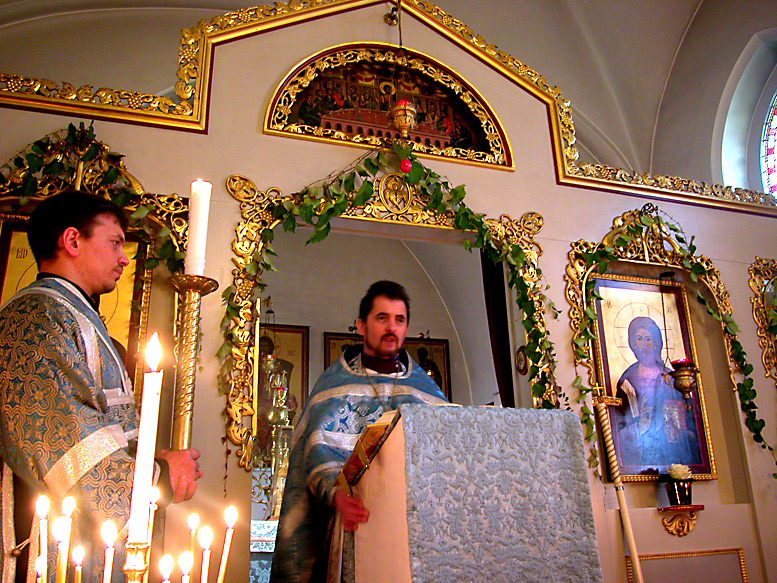
| Greenery and life | Many parishes decorate with green as a sign of life, renewal, and the Spirit's work in creation. |
| Kneeling prayers | At Pentecost Vespers, the Church returns to kneeling prayers after the Paschal season. |
| All Saints | The Sunday after Pentecost shows the fruit of the Holy Spirit in the saints of the Church. |
Feast Map
Pentecost is the Church receiving life in the Holy Spirit.
For readers coming from search, this is the cleanest map: Pentecost belongs to Pascha, reveals the Holy Trinity, sends the apostles, restores kneeling prayer, and bears visible fruit in the saints.
Orthodox worship receives Pentecost as life in the Father, the ascended Son, and the Holy Spirit. In many Orthodox calendars the day is also kept as Trinity Sunday.
Read the Holy TrinityThe apostles are gathered as the Church and sent into witness. Pentecost corrects both isolated spirituality and mission detached from worship.
Read Orthodox ChristianityMany parishes serve Pentecost Vespers with kneeling prayers. Practice and timing vary locally, so the safest guide is the parish calendar and priest.
Read Orthodox VespersThe Sunday after Pentecost honors all saints. In many Orthodox calendars, the Apostles' Fast then begins after All Saints Sunday and leads toward Saints Peter and Paul.
Read the Apostles' FastHow To Read It
Keep the feast inside worship, not internet shortcuts.
Good Orthodox teaching does not flatten Pentecost into a slogan such as "the Church's birthday" and stop there. The phrase can be useful, but only if the reader also sees the Trinity, Pascha, Ascension, apostolic witness, repentance, saints, and parish life.
- Do not detach it from Pascha.Pentecost completes the fifty-day Paschal season. It is the fulfillment of resurrection joy in the gift of the Holy Spirit.
- Do not detach it from the Church.The Spirit does not create a private spirituality. He gathers the faithful into worship, sacraments, confession, mission, and holiness.
- Do not absolutize local customs.Greenery, exact service order, kneeling practice, and calendar terminology can differ. The local parish and bishop's calendar matter.
Why Pentecost matters for daily prayer
Prayer is not only human effort. Orthodox prayer is life in the Holy Spirit. Pentecost reminds the faithful that repentance, Scripture, the sacraments, icons, fasting, and mercy are not private religious projects. They belong to the life of the Church.
For someone using a daily prayer app, Pentecost is a reminder that a rule of prayer should not become mechanical. Prayer is meant to be personal, ecclesial, humble, and open to the grace of God.
The Church as the fruit of Pentecost
Pentecost is sometimes described as the birthday of the Church, but that phrase should not make the feast sound sentimental. The apostles are empowered to preach Christ to the nations, and the Church appears as the communion of people gathered by the Holy Spirit. The feast therefore belongs to mission, parish life, repentance, and the holiness of the saints.
The Sunday after Pentecost is All Saints in the Orthodox calendar. That placement is theological: the saints are the visible fruit of the Spirit's work in human lives. Pentecost is not only an event in Acts; it is the continuing life of the Church in holiness.
Why the kneeling prayers matter
During the Paschal season, Orthodox worship emphasizes standing in the joy of the Resurrection. At Pentecost Vespers, many parishes return to kneeling with long prayers asking for mercy, renewal, and the grace of the Holy Spirit. The change of posture teaches something: joy does not abolish repentance; it heals and deepens it.
For newcomers, the kneeling prayers can be powerful because they show Orthodox worship as both bodily and theological. The body is not left outside prayer. Standing, bowing, kneeling, crossing oneself, fasting, and receiving the sacraments all confess that salvation touches the whole person.
Pentecost after the app reminder
A reminder can help people remember that Pentecost is fifty days after Pascha, that kneeling prayers may be served, and that All Saints follows. But Pentecost is not learned by date calculation alone. The feast is learned in the Church's prayer, in the invocation of the Holy Spirit, and in the life of the parish.
Orthodox Daily Prayer can help connect Pentecost to the Trinity, the saints, the Paschal cycle, Scripture, and daily prayer. The deeper point is that prayer itself is life in the Holy Spirit, not a personal productivity routine.
Greenery, renewal, and local custom
Many Orthodox parishes decorate with greenery for Pentecost as a sign of life and renewal. Customs differ by local Church and parish. The greenery should not be reduced to seasonal aesthetics; it points toward the Spirit's life-giving work in the Church and in creation.
As with all customs, the meaning is learned best in parish worship. Decorations, colors, kneeling prayers, hymns, and readings work together. The feast is not only explained by paragraphs; it is received by standing in the Church's prayer.
What Pentecost corrects
Pentecost corrects the idea that Christianity is only memory of Jesus from the past. The risen and ascended Christ sends the Holy Spirit, and the Church lives by that gift now. It also corrects the idea that spirituality is private self-improvement. The Spirit gathers the Church, creates communion, sends mission, and forms saints.
This is why Pentecost naturally leads to All Saints. The Spirit's work is visible in actual human holiness: martyrs, confessors, monastics, pastors, families, missionaries, repentant sinners, and hidden righteous people.
How to keep Pentecost beyond Sunday
A person can keep Pentecost by attending the Liturgy and Vespers where possible, listening to the kneeling prayers, reading Acts, praying to the Holy Spirit, and noticing the Sunday of All Saints that follows. The goal is not only to know that Pentecost happened, but to live more consciously as a member of Christ's Spirit-filled Church.
For beginners, a simple practice is to read Acts 2, pray "O Heavenly King" when appropriate in the liturgical season, and ask how the Holy Spirit is calling the person toward repentance, parish life, service, and holiness.
Pentecost for people discovering Orthodoxy
Pentecost helps explain why Orthodoxy is not only preservation of ancient forms. The Church keeps ancient worship because she lives by the Holy Spirit, not because old things are automatically holy. Tradition is not nostalgia; it is the Spirit-bearing life of the Church handed down and received.
For someone coming from a highly individual religious background, Pentecost can be especially clarifying. The Spirit does not create isolated spiritual consumers. He gathers people into the Body of Christ, teaches them to pray, sends them into mission, and bears fruit in saints whose lives become evidence of grace.
Common questions about Orthodox Pentecost
When is Orthodox Pentecost?
Orthodox Pentecost is celebrated fifty days after Pascha. Because Pascha is movable, the date changes each year.
Why is Pentecost connected with the Holy Trinity?
Pentecost reveals the life of the Church in the Holy Trinity: the Father sends the Spirit, the Son has ascended in glory, and the Church is filled with the Holy Spirit.
What are the kneeling prayers of Pentecost?
At Pentecost Vespers, many Orthodox parishes pray kneeling prayers, marking the return to kneeling after the Paschal season and asking for the grace of the Holy Spirit.
Why is All Saints right after Pentecost?
The Sunday after Pentecost shows the fruit of the Holy Spirit in the saints. Holiness is not an abstract idea; it is the Spirit's work in human lives.
Can Pentecost be understood apart from parish life?
No. Pentecost reveals the Church as life in the Holy Spirit, so it belongs to worship, sacraments, mission, holiness, and concrete parish life.
Pentecost study path
Read Pentecost together with Pascha, Ascension, the Trinity, and the saints.
Source note
This guide follows Orthodox liturgical teaching on Pentecost, the descent of the Holy Spirit, the kneeling prayers, and the connection between Pentecost and All Saints. Local service customs should be confirmed through the parish calendar.
Source Trail
Read this topic with the Church, not only the internet.
These links give a cautious path for checking the topic further. They do not replace parish worship, confession, pastoral guidance, or the calendar used by your bishop and local parish.
Life In The Spirit
Follow Pentecost as prayer, not just a movable date.
Orthodox Daily Prayer helps connect the Paschal cycle, Scripture, saints, feasts, and daily prayer without reducing worship to reminders.
Pentecost service customs can vary. Follow your parish calendar for the date, service times, and local practice.